grains, cereals, and what’s the hype?
Posted by Greta Williams - Mar 30, 2015
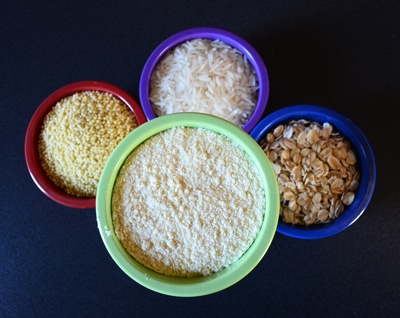
There is a lot of buzz in the baby food realm regarding cereals. To feed or not to feed….seems to be the question. And everyone is willing to share his or her opinion to those first-time parents out there. So do you listen to Granny’s recommendation to put rice cereal in a bottle to promote better sleep? Do you follow the newest trends and steer clear of all grains until after baby’s first year of life? Here’s a look at the pros, cons, and whys of it all—thrown in with a few recommendations.
“It’s the way we did it.” You’ll often hear that from those promoting cereals for young babies. True, it may have been. But after much research, it turns out that feeding baby rice cereal in a bottle before bed doesn’t really correlate to sleeping longer. Breastfed babies often cluster-feed around bedtime to make it through the night. With this in mind, perhaps offer another small bottle of formula before bed and save the cereal for a later age.
Instant cereals—beware. If you’ve heard me talk in person, you know I’m very passionate about instant cereal versus REAL grains. We are a sugar-addicted society that is only growing in obesity and disease (sorry, that was a rather glum statement). If you remember only one thing from this post, may it be this: instant cereals have little nutritional value and often come with harmful chemicals and additives, flavouring, and sugars.
Real Grains—that’s the stuff. If you’re going to introduce grains into your baby’s diet, consider using a whole grain and grinding it. You can start introducing whole grains at 6 months, if ground. The grinding is not done to smooth consistency, but to aid in digestion from 6-8 months. Cook it to a 4:1 ratio with water for 10 minutes.* While traditionally we think of rice cereal as baby’s first grain, it is actually the most difficult grain to digest. I strongly recommend Millet and Oats (organic if you can afford it) as baby’s first grain. They’re easiest on the digestion system and offer a great variation of tastes. When baby is 7 months, quinoa can be introduced and after 8 months, you can add brown rice. Other grains & proteins (barley, amaranth, ground lentils, ground dried beans) can be prepared this same way and blended with fruits & veggies.
Waiting on grains—completely. The latest trend is to wait until after the first year to introduce grains. This too is based on baby’s digestive system and readiness of the body. If choosing this method, be sure to introduce many types of vegetables and proteins.
At the end of the day, you must do what you feel is right for your baby and your situation. Do some additional research and ask questions from trusted sources. I’ll end with saying that whether you introduce early or late, do try to make sure the food you feed your baby is as REAL as possible. As always Nurture your baby Naturally.
*For tips & full cooking instructions of ground grains, email me at NurtureNaturallyPE@gmail or message me on facebook.
March 2015 | Comments | 1 Love |

about the author
After giving birth to a premature son with numerous medical issues, I learned that breastfeeding and an all-natural diet would give him the best chance of someday being medication-free. Ten years, and tons of research later, I am inspired to share my accomplishments... and warn of my mistakes.
In 2007 I became a trained spokesperson for the Feingold Association, dedicated to using diet to help combat the 4 A’s: asthma, allergies, autism, and ADHD (It is estimated that 1:3 children are now diagnosed with at least one of these aliments). I am also a nationally (United States) certified Bradley® Natural Childbirth instructor advocating for unmedicated births. I have recently spoken on behalf of Feingold for ADHASA, a South African organization dedicated to help those learning to live with ADD and ADHD. Most recently I’ve been asked by Feingold to head the South African side of Feingold, both online and in speaking engagements.
Feeding my children homemade, healthy food is the most rewarding job I have ever had, but I did feel overwhelmed and frustrated at times. I hope that through chatting to parents through sites such as these, as well as offering one-on-one consults, parents will obtain the knowledge and confidence they need to ensure healthy eating habits for the future.
As a result of my experience with my children, my love of all things natural, and my nutrition education through Feingold, I started Nurture Naturally in 2013. The aim is to make healthy options easy and affordable. For those working, busy or kitchen-phobic parents, I offer a wide variety of healthy options to ensure baby’s health. Nurture Naturally makes baby food the way it should be—naturally. The food is free of preservatives, fillers, additives, sweeteners, flavours, and colours. Instead it is full of tastes, textures, and nutrients essential to baby’s constantly growing body.
I strongly believe that everyone would benefit from a natural diet and limited artificial substances.
popular posts
Mar 14, 2016
Ilze is mom to six year old Ceri and five year old Trace who has Down Syndrome. This single, working mom says that her mothering journey has...
Mar 23, 2015
We are super excited to share our first Mom of the Month feature with our readers. Kelly is a beautiful, inspiring mom who is full of joy and an...
Mar 24, 2015
Welcome to My Mama Made It! Thank you for taking the time out of your busy day to read the musings of a creative mom, wife, and entrepreneur.